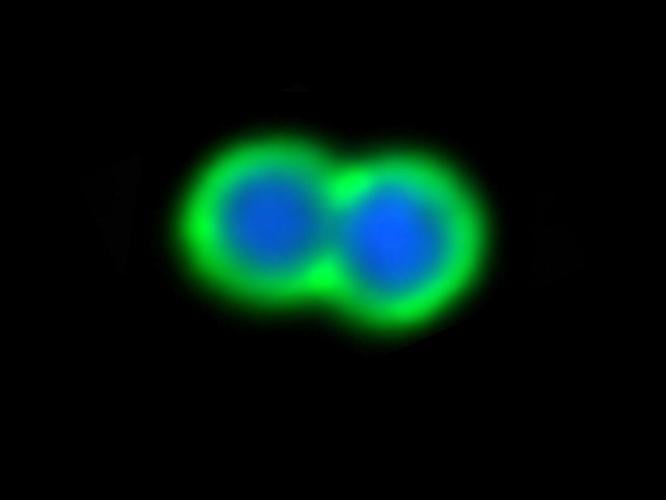
A strain of Neisseria gonorrhoeae stained with a monoclonal antibody. // Drug resistant superbugs could be beaten by treating diseases with human antibodies, suggests a new study. The overuse of antibiotics is increasingly leading to the emergence of infectious superbugs - dangerous bacteria that have developed antimicrobial resistance (AMR) and are therefore much harder, if not impossible, to eliminate from the body. Now researchers have highlighted the "promise" of using human monoclonal antibodies (mAbs) to treat patients more effectively and tackle AMR. Study corresponding author Professor Rino Rappuoli said: ÂThe strategy of solving AMR using only new antibiotics has failed completely and is generating monster bacteria that are resistant to all of them.
A hypervirulent and pan-resistant strain of Klebsiella pneumoniae stained with monoclonal antibodies against the capsule (green) and the O-antigen (yellow). (Rino Rappuoli via SWNS)
A strain of Neisseria gonorrhoeae stained with a monoclonal antibody. // Drug resistant superbugs could be beaten by treating diseases with human antibodies, suggests a new study. The overuse of antibiotics is increasingly leading to the emergence of infectious superbugs - dangerous bacteria that have developed antimicrobial resistance (AMR) and are therefore much harder, if not impossible, to eliminate from the body. Now researchers have highlighted the "promise" of using human monoclonal antibodies (mAbs) to treat patients more effectively and tackle AMR. Study corresponding author Professor Rino Rappuoli said: ÂThe strategy of solving AMR using only new antibiotics has failed completely and is generating monster bacteria that are resistant to all of them.
A hypervirulent and pan-resistant strain of Klebsiella pneumoniae stained with monoclonal antibodies against the capsule (green) and the O-antigen (yellow). (Rino Rappuoli via SWNS)