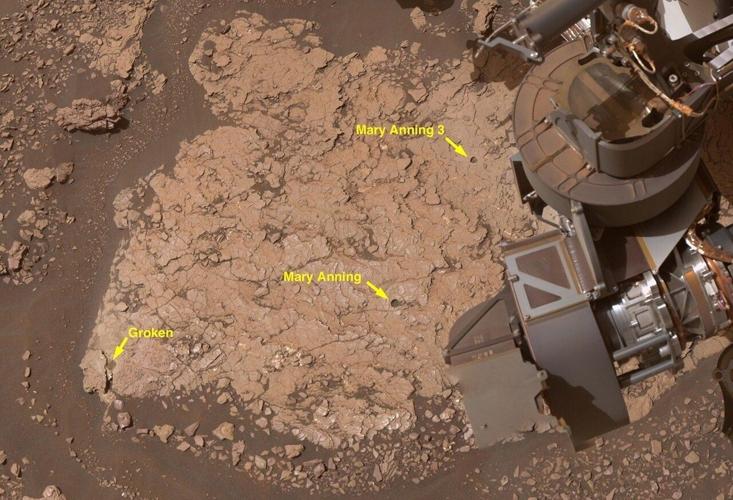
The sample locations where Curiosity snagged three samples of drilled rock at this site on its way out of the Glen Torridon region. Analyzing these samples revealed diverse organic molecules on Mars. (NASA / JPL-Caltech / MSSS via SWNS)
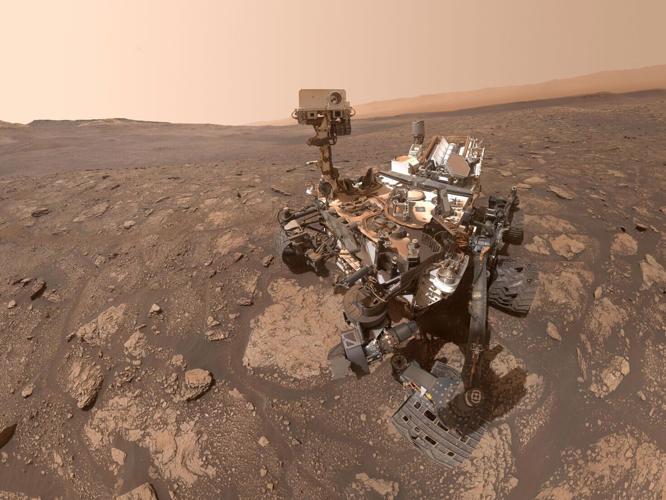
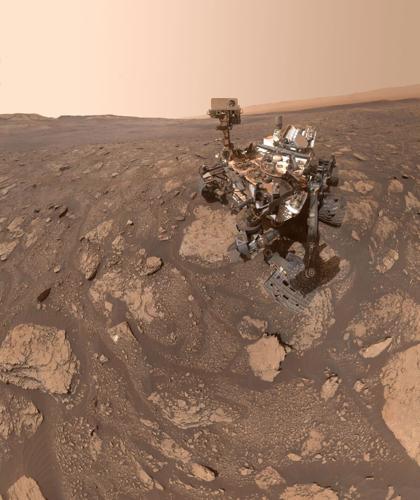
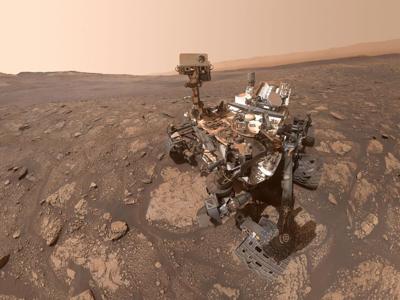
NASA's Curiosity Mars rover took this selfie at a location nicknamed "Mary Anning" after a 19th century English paleontologist. This was the site of the chemical experiment uncovering diverse organic molecules on Mars, in the Glen Torridon region, which scientists believe was a site where ancient conditions would have been favorable to supporting life, if it ever was present. (NASA / JPL-Caltech / MSSS via SWNS)
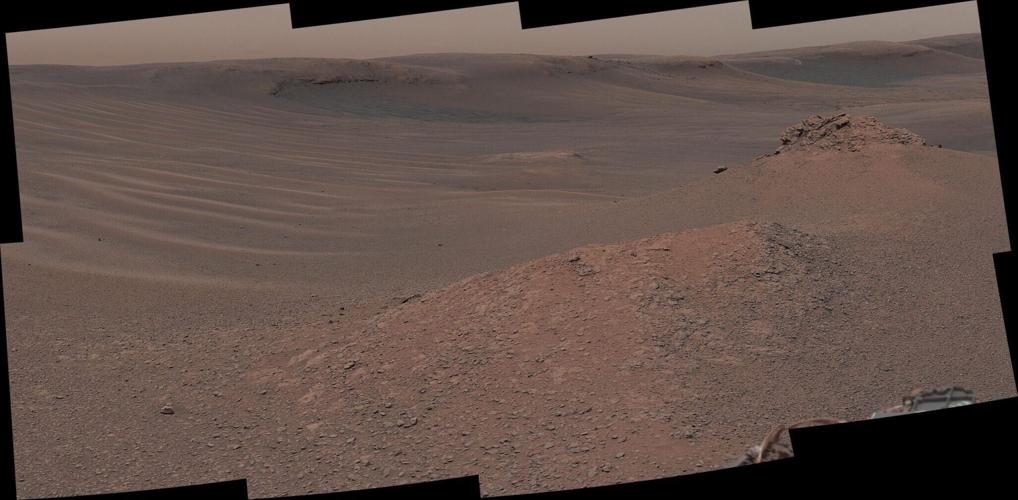
The Mast Camera (Mastcam) on NASA's Curiosity Mars rover captured this mosaic as it explored the ""clay-bearing unit"" on Feb. 3, 2019 (Sol 2309) where samples were taken that identified diverse organic molecules on Mars. (NASA / JPL-Caltech / MSSS via SWNS)
The sample locations where Curiosity snagged three samples of drilled rock at this site on its way out of the Glen Torridon region. Analyzing these samples revealed diverse organic molecules on Mars. (NASA / JPL-Caltech / MSSS via SWNS)
NASA's Curiosity Mars rover took this selfie at a location nicknamed "Mary Anning" after a 19th century English paleontologist. This was the site of the chemical experiment uncovering diverse organic molecules on Mars, in the Glen Torridon region, which scientists believe was a site where ancient conditions would have been favorable to supporting life, if it ever was present. (NASA / JPL-Caltech / MSSS via SWNS)
The Mast Camera (Mastcam) on NASA's Curiosity Mars rover captured this mosaic as it explored the ""clay-bearing unit"" on Feb. 3, 2019 (Sol 2309) where samples were taken that identified diverse organic molecules on Mars. (NASA / JPL-Caltech / MSSS via SWNS)