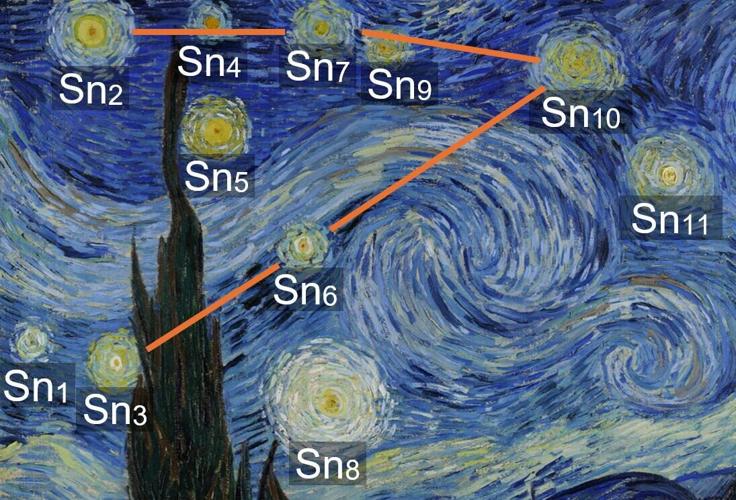
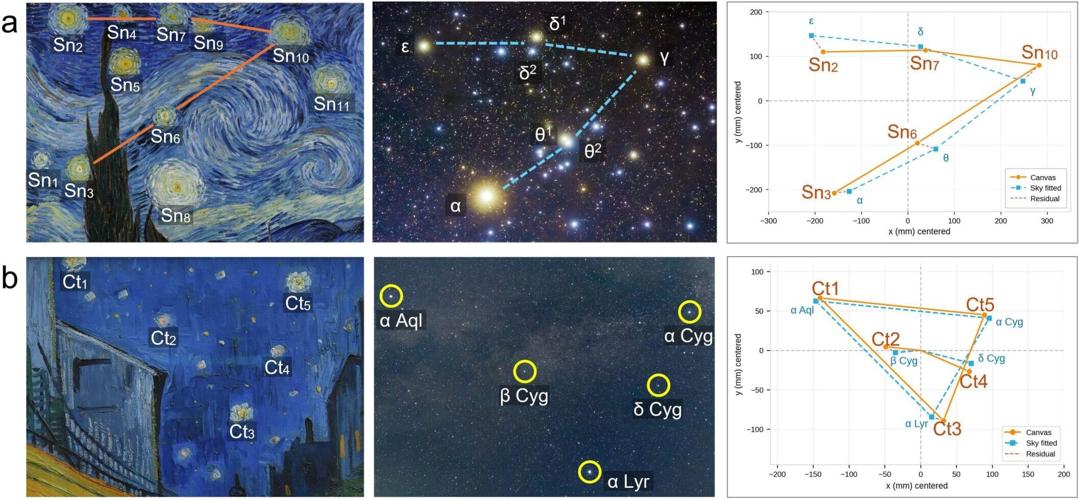
a) The central cluster of stars in The Starry Night (1889), left, and the Hyades cluster in Taurus, center. At right, the five stars in the painting (orange) are overlaid on the real stars (blue) after matching for size, orientation and position; red dashed lines show the residual differences. (b) The stars in Café Terrace at Night (1888), left, and the stars around the Summer Triangle, center. The panel at right follows the same layout as in (a). (Kim et al. via SWNS)
(a) The central cluster of stars in The Starry Night (1889), left, and the Hyades cluster in Taurus, center. At right, the five stars in the painting (orange) are overlaid on the real stars (blue) after matching for size, orientation and position; red dashed lines show the residual differences. (b) The stars in Café Terrace at Night (1888), left, and the stars around the Summer Triangle, center. The panel at right follows the same layout as in (a). (Kim et al. via SWNS)
a) The central cluster of stars in The Starry Night (1889), left, and the Hyades cluster in Taurus, center. At right, the five stars in the painting (orange) are overlaid on the real stars (blue) after matching for size, orientation and position; red dashed lines show the residual differences. (b) The stars in Café Terrace at Night (1888), left, and the stars around the Summer Triangle, center. The panel at right follows the same layout as in (a). (Kim et al. via SWNS)
By Talker
By Stephen Beech
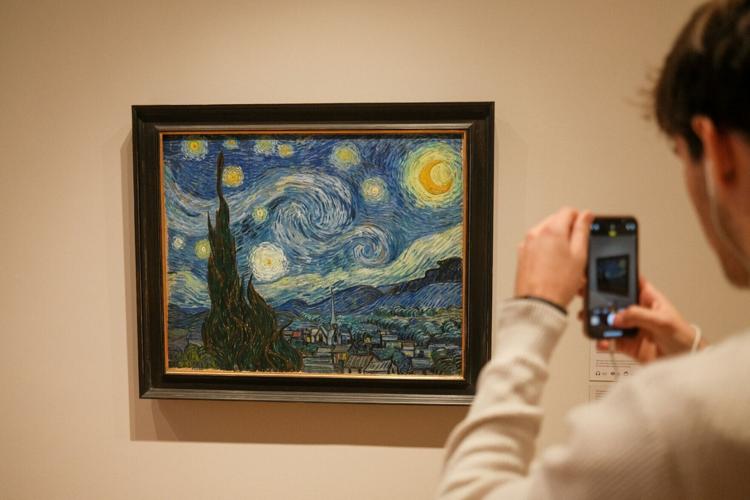
Vincent van Gogh’s “The Starry Night” sky matches that of a date in July 1889, according to new research.
(a) The central cluster of stars in The Starry Night (1889), left, and the Hyades cluster in Taurus, center. At right, the five stars in the painting (orange) are overlaid on the real stars (blue) after matching for size, orientation and position; red dashed lines show the residual differences. (b) The stars in Café Terrace at Night (1888), left, and the stars around the Summer Triangle, center. The panel at right follows the same layout as in (a). (Kim et al. via SWNS)