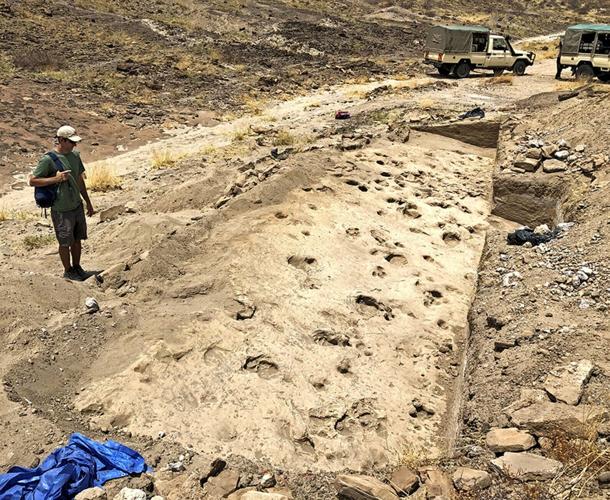
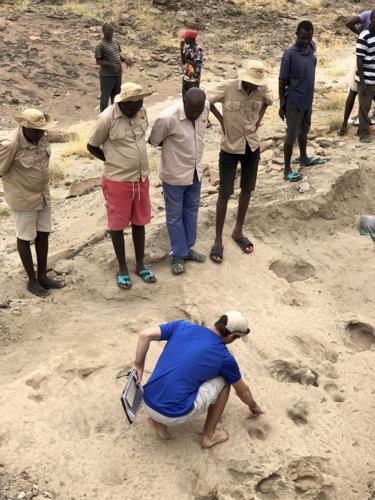
Overview of the excavated track surface with a mix of deeper hippopotamus and antelope footprints and shallower hominin tracks visible. (Kay Behrensmeyer / Smithsonian via SWNS)
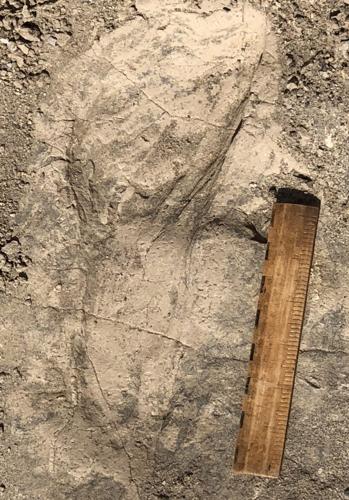
One of the larger hominin footprints with a 6-ruler for scale. The tracks were made in soft mud and then filled in with sand by gentle shoreline currents, preserving the impressions. (Kay Behrensmeyer / Smithsonian via SWNS)
Study lead Kevin Hatala, an associate professor of biology at Chatham University in Pittsburgh and an associate researcher at the Max Planck Institute for Evolutionary Anthropology in Leipzig, Germany, pointing out footprints of hominins among deeper hippopotamus tracks. (Kay Behrensmeyer / Smithsonian via SWNS)
Overview of the excavated track surface with a mix of deeper hippopotamus and antelope footprints and shallower hominin tracks visible. (Kay Behrensmeyer / Smithsonian via SWNS)
By Talker
By Stephen Beech
Fossil footprints reveal that an ancient human relative was much taller than previously thought and travelled in groups 1.4 million years ago.
One of the larger hominin footprints with a 6-ruler for scale. The tracks were made in soft mud and then filled in with sand by gentle shoreline currents, preserving the impressions. (Kay Behrensmeyer / Smithsonian via SWNS)
Study lead Kevin Hatala, an associate professor of biology at Chatham University in Pittsburgh and an associate researcher at the Max Planck Institute for Evolutionary Anthropology in Leipzig, Germany, pointing out footprints of hominins among deeper hippopotamus tracks. (Kay Behrensmeyer / Smithsonian via SWNS)
...HEAT ADVISORY REMAINS IN EFFECT FROM 10 AM TO 9 PM CDT TUESDAY...

* WHAT...Maximum heat index values of 105 to 109 expected on Tuesday.

* WHERE...A portion of central Alabama.

* WHEN...From 10 AM to 9 PM CDT Tuesday.

* IMPACTS...Hot temperatures and high humidity may cause heat
illnesses.

PRECAUTIONARY/PREPAREDNESS ACTIONS...

Drink plenty of fluids, stay in an air-conditioned room, stay out of
the sun, and check up on relatives and neighbors.

Take extra precautions when outside. Wear lightweight and loose
fitting clothing. Try to limit strenuous activities to early morning
or evening. Take action when you see symptoms of heat exhaustion and
heat stroke.

To reduce risk during outdoor work, the Occupational Safety and
Health Administration recommends scheduling frequent rest breaks in
shaded or air conditioned environments. Anyone overcome by heat
should be moved to a cool and shaded location. Heat stroke is an
emergency! Call 9 1 1.

&&