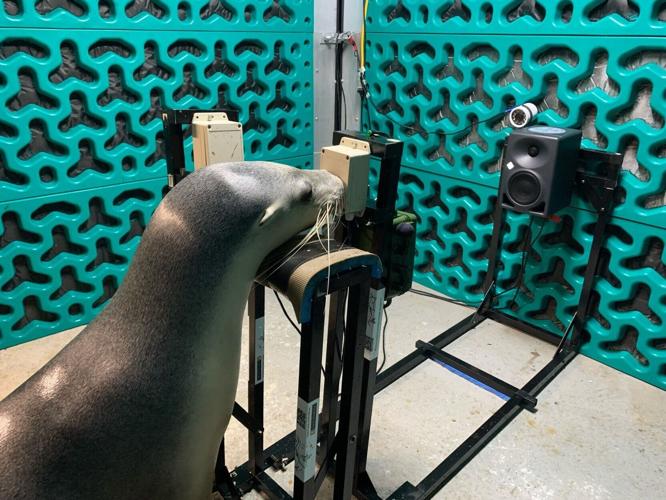
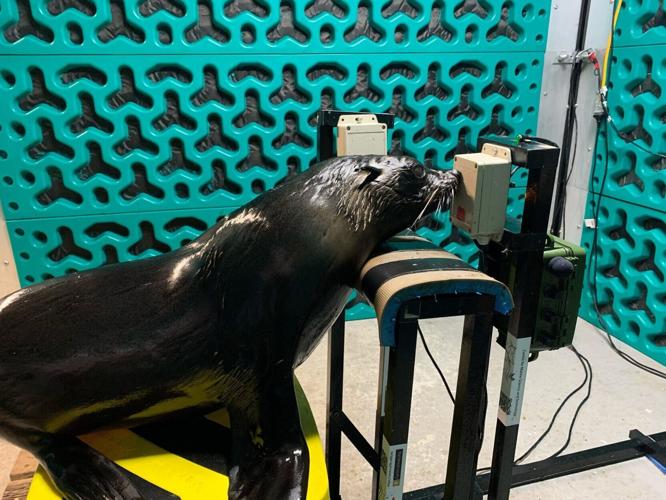
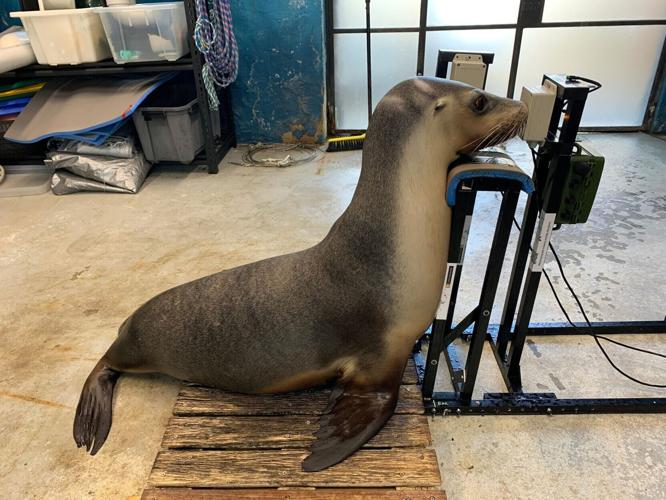
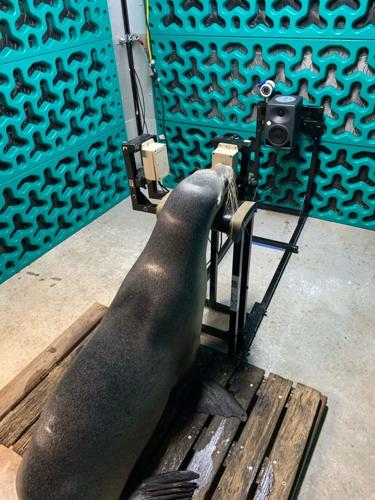
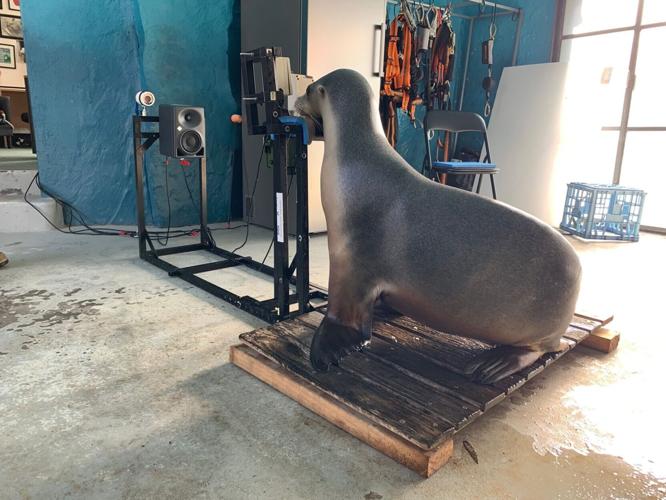
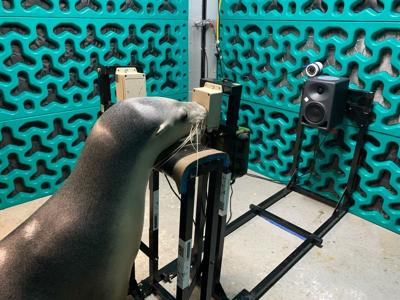
Nala the sea lion doing a hearing test. // Seals and sea lions have been trained to take hearing tests to begin to understand how much human noise bothers them. Researchers from Curtin University and Taronga Conservation Society Australia have used the study to reveal what sounds these marine mammals can hear and helping assess how human-made noise could affect them. Marine Keepers trained two Australian sea lions and two long-nosed fur seals at Taronga Zoo Sydney to respond to sounds by pressing a paddle when they heard a tone, with the mammals rewarded with fish for correct responses. Both species were most sensitive to sounds around 3.2 kilohertz, providing the first detailed baseline of hearing sensitivity for the two Australian species. Lead researcher Professor Christine Erbe, from CurtinÂs Centre for Marine Science and Technology, said understanding what the animals could hear was an important first step in assessing the potential impacts of noise from human activity.
Nala the sea lion doing a hearing test. // Seals and sea lions have been trained to take hearing tests to begin to understand how much human noise bothers them. Researchers from Curtin University and Taronga Conservation Society Australia have used the study to reveal what sounds these marine mammals can hear and helping assess how human-made noise could affect them. Marine Keepers trained two Australian sea lions and two long-nosed fur seals at Taronga Zoo Sydney to respond to sounds by pressing a paddle when they heard a tone, with the mammals rewarded with fish for correct responses. Both species were most sensitive to sounds around 3.2 kilohertz, providing the first detailed baseline of hearing sensitivity for the two Australian species. Lead researcher Professor Christine Erbe, from CurtinÂs Centre for Marine Science and Technology, said understanding what the animals could hear was an important first step in assessing the potential impacts of noise from human activity.